
| The Bank of England kept interest rates unchanged at 3.75% in September but warned of potential rates rise | The Organisation for Economic Co-operation and Development (OECD) expects global GDP to grow by 2.9% in 2026 | The Office for National Statistics (ONS) reported public sector borrowing of £18.3bn, £2.9bn more than a year earlier |
The Bank of England kept interest rates unchanged at 3.75% in September but warned that a prolonged period of higher energy prices could force policymakers to raise rates.
The Monetary Policy Committee (MPC) voted six to three to leave Bank Rate unchanged. The three dissenting members wanted an immediate 0.25 percentage-point increase to 4%, arguing that acting now would help prevent higher inflation becoming embedded in wages and prices. The Bank’s concerns centre on the continuing conflict in the Middle East, which has pushed up oil, gas and refined energy prices. Higher costs are already feeding through to households and businesses, while the Bank warned that the longer energy prices remain elevated, the greater the risk of wider inflationary pressures developing.
Consumer Prices Index (CPI) inflation rose to 3.1% in August, well above the Bank’s 2% target. Based on energy prices in mid-September, the Bank now expects inflation to reach around 3.75% during the final quarter of 2026 and slightly above 4% in early 2027. Household inflation expectations have also risen as energy prices have increased. However, the MPC has so far seen limited evidence that the energy shock is leading to sustained increases in wages and prices across the wider economy. A relatively soft labour market and higher borrowing costs are also expected to help contain inflation.
Bank of England Governor Andrew Bailey said, “The longer this volatility persists, the bigger the impact it will have on inflation, and the more likely it is we will need to raise Bank Rate.”
MPC members therefore appear prepared to wait for further evidence before tightening monetary policy, while making clear that the risks to inflation have increased. The next rate decision will be announced on 5 November.
The Organisation for Economic Co-operation and Development (OECD) has slightly upgraded its outlook for the global economy this year, despite the disruption caused by conflict in the Middle East and renewed inflationary pressures.
OECD, which publishes forecasts for individual economies and the global economy, now expects global gross domestic product (GDP) to grow by 2.9% in 2026, up from its previous forecast of 2.8%. It lowered its forecast for 2027 from 3.1% to 3.0%. Economic activity has held up better than anticipated as disruption to energy supplies has been contained by high oil inventories and increased production outside the Gulf. Continued investment in artificial intelligence has also supported production, trade and economic growth. However, OECD warned that higher energy and food prices are putting pressure on household purchasing power, while weaker real-income growth and higher interest rates are expected to restrain demand. Further disruption to energy supplies could also push inflation higher and weaken economic growth.
For the UK, OECD expects GDP to grow by 1.1% in 2026 and 1.0% in 2027. This compares with its previous forecasts of 0.9% and 1.1%, respectively. Recently announced government measures to reduce household living costs are expected to support consumer spending, although overall economic growth is forecast to remain subdued.
The outlook comes as Chancellor John Healey used his “Growth Britain” speech to set out the government’s plans to increase productivity, encourage private sector investment and create jobs while maintaining fiscal discipline.
Healey said, “Growth is the only way we can sustainably improve living standards, fund our public services and strengthen our public finances.” The Chancellor highlighted greater economic devolution, infrastructure and business investment, and measures to reduce barriers to business growth.
At the end of September, most major global indices ended in negative territory month-on-month. Some European and US stocks trended lower toward month end, while oil prices retreated from recent surges, bond yields moved higher and investors awaited key inflation data from the US.
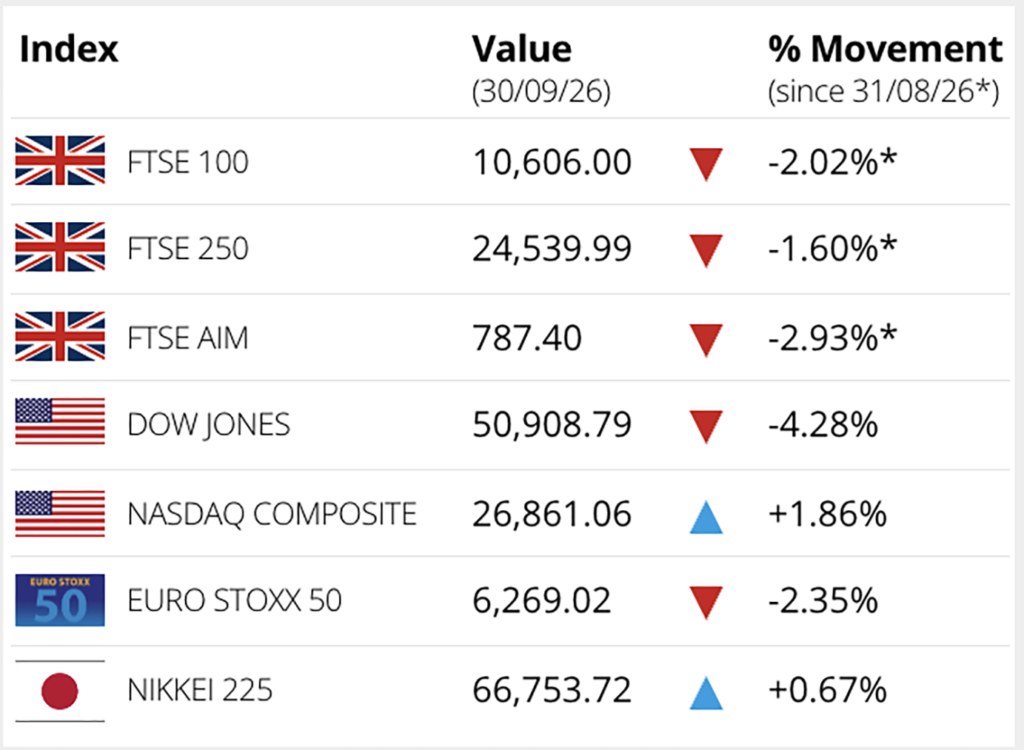
On 30 September, data showed the US economy grew faster-than-expected in Q2, while inflation cooled more than projected. Mid-month the Federal Reserve raised interest rates for the first time in over three years, renewing its fight against inflation. The Dow Jones fell over 4% in September to close on 50,908.79. The NASDAQ recorded a monthly gain of 1.86% to close on 26,861.06.
On home shores, the blue-chip FTSE 100 index closed September down 2.02% on 10,606.00, while the FTSE 250 lost 1.60% to close on 24,539.99. The FTSE AIM Index fell 2.93% to close on 787.40. In Japan, the Nikkei 225 recorded a 0.67% gain in the month, closing at 66,753.72. On the continent, the Euro Stoxx 50 dropped 2.35% in September to close the month on 6,269.02.
On foreign exchanges, the euro closed the month at €1.16 against sterling. The US dollar closed at $1.32 against sterling and at $1.13 against the euro.
Brent crude oil closed September up over 12% at $98.94 a barrel. Following a jump in prices, they reversed course after President Trump said he expected talks with Iran to develop and reports emerged that considerable volumes are continuing to flow from the region. Gold finished the month trading around $4,192 a troy ounce, a loss of over 6% in the month. The precious metal extended declines toward the end of the month on the back of US dollar strength.
Government borrowing rose sharply in August, putting pressure on the new Chancellor ahead of October’s Budget, as higher borrowing costs increase the strain on the public finances.
The Office for National Statistics (ONS) reported public sector borrowing of £18.3bn, £2.9bn more than a year earlier and £3.5bn above the Office for Budget Responsibility (OBR) forecast. Borrowing during the financial year to August reached £77.3bn, £8.1bn more than forecast.
Higher debt-interest payments have increased the strain on public finances. The government spent £8.8bn servicing its debt in August, the highest August figure since records began in 1997. Of this, £2.1bn reflected the impact of higher inflation on index-linked government bonds, where interest payments rise in line with inflation. Pressure on the Chancellor has also come from the bond market. The yield on 10-year UK government bonds, or gilts, reached 5.41% during September, its highest level since 2007, amid a wider global bond sell-off driven partly by concerns over energy prices and inflation. Higher gilt yields increase the cost of government borrowing, leaving Healey with less flexibility when deciding whether to increase spending, cut taxes or preserve fiscal headroom at the Budget.
The GfK Consumer Confidence Barometer increased by one point to -13 in September, its third consecutive monthly rise and the highest reading since August 2024. Economists had predicted consumer confidence would falter.
Households reported feeling better about both their own finances and the wider economy. Confidence in personal finances over the past year rose three points to -3, while expectations for the next 12 months increased one point to +5. Views on the UK economy over the previous year improved four points to -36, with expectations for the coming year also edging higher.
However, there were signs that consumers remain cautious. GfK’s Major Purchase Index, which measures appetite for big-ticket spending, slipped one point to -8, while its separate Savings Index climbed five points to +27.
Neil Bellamy, Consumer Insights Director at GfK, commented on the data, “This marks the first time since summer 2024 that we have seen three consecutive monthly increases in the Overall Index Score.
However, the return of higher inflation removes one of the strongest positives seen in previous months.” He continued, “So, while the headline score continues to improve, confidence is still firmly in negative territory. With inflation, energy and fuel prices rising, could we soon see consumer sentiment falter?”
All details are correct at the time of writing (1 October 2026)
The value of investments can go down as well as up and you may not get back the full amount you invested. The past is not a guide to future performance and past performance may not necessarily be repeated.
It is important to take professional advice before making any decision relating to your personal finances. Information within this document is based on our current understanding and can be subject to change without notice and the accuracy and completeness of the information cannot be guaranteed. It does not provide individual tailored investment advice and is for information only. We cannot assume legal liability for any errors or omissions it might contain. No part of this document may be reproduced in any manner without prior permission.